
Fuel information from CAN
-

Fuel information from CAN
Monitoring fuel information from the vehicle’s CAN bus is mostly used with passenger cars and vans.
Does fuel control matter?
You probably know how costly fuel can be for a company.
If you want to keep expenses under control, it is important to find ways to increase fuel economy.
Based on 14 years of experience, customers using the Navirec fuel control solution have reduced their fuel expenses by up to 30%.

Fuel information from CAN bus
CAN bus is an information channel connected to the GPS controller.
It is mostly used for monitoring important vehicle parameters, including fuel data, of passenger vehicles and trucks.
NOTE: Since CAN bus is still a relatively new technology and has no unified standard, it is not supported by all car producers in the same way. For this reason, prior confirmation is needed that the service is suitable for your vehicle.

Fuel information received from the brain of the vehicle
- refuel quantity
- consumed fuel quantity
- average fuel consumption of the vehicle
- fuel consumption per work hour

Accurate and clear overview of fuel consumption

Track and compare the fuel consumption of your vehicles
With CAN fuel information, you can track fuel consumption across your company’s vehicle fleet and compare average consumption between different vehicles and time periods.
You can also compare drivers’ routes, driving styles and fuel consumption to identify where efficiency can be improved.

View fuel residue in the tank
The fuel residue and changes in the fuel tank shown in Navirec help plan routes and refueling more accurately.

Monitor changes in fuel level
You can see the exact time when the fuel level changes in the tank.
On the map, you can view specific refueling locations and moments when fuel level drops suddenly, for example because of a technical issue or possible fuel theft.

Create detailed fuel reports
Compare drivers, vehicles, driving routes and other relevant data in order to make better decisions when planning work and fleet use.

Better planning means more effective work organization and cost savings.


 FMC150 4G TELTONIKA GPS TRACKER
Dimensions: 65*56.6*20.6 mm. Standby time: 7*24 hours. Moisture resistance: IP41.
Price 99 € - 147 € VAT incl. pcs
 FMM150 M1 TELTONIKA GPS TRACKER
Dimensions: 65*56.6*20.6 mm. Standby time: 7*24 hours. Moisture resistance: IP41.
Price 103 € - 165 € VAT incl. pcs
 FMC150 TACHO 4G TELTONIKA GPS TRACKER
Dimensions: 65*56.6*20.6 mm. Standby time: 7*24 hours. Moisture resistance: IP41.
Price 109 € - 157 € VAT incl. pcs
 FMC150 4G TELTONIKA GPS TRACKER EXTENDED CAN
Dimensions: 65*56.6*20.6 mm. Standby time: 7*24 hours. Moisture resistance: IP41.
Price 133 € - 181 € VAT incl. pcs
 FMB140 2G LV-CAN200 TELTONIKA GPS TRACKER
Dimensions: 65*56.6*20.6 mm. Waiting time: 7*24 hours. Moisture resistance: IP41.
Price 88 € - 136 € VAT incl. pcs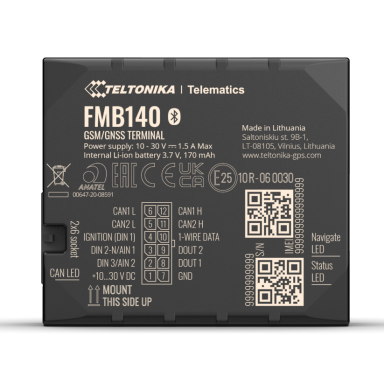
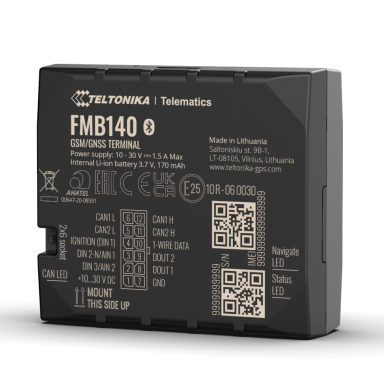 FMB140 2G ALL-CAN300 TELTONIKA GPS TRACKER
Dimensions: 65*56.6*20.6 mm. Waiting time: 7*24 hours. Moisture resistance: IP41.
Price 155 € - 203 € VAT incl. pcs
 FMC250 4G Teltonika GPS tracker
Dimensions:70.5*67*25.6 mm. Standby time: 7*24. IP67.
Price 109 € - 157 € VAT incl. pcs
 LV-CAN200+DTC
DTC- Diagnostic Trouble Code. Is a code used to diagnose malfunctions in a vehicle or heavy equipment.
Price 75 € VAT incl. pcs


